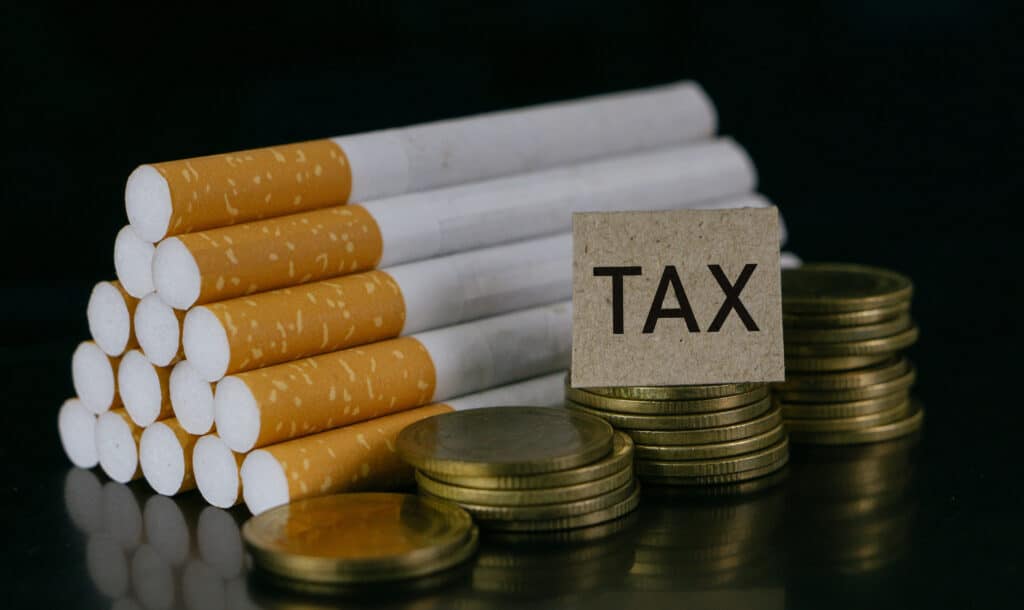
Italy: Limited increase in tobacco excise duties in 2027
November 7, 2026
Par: National Committee Against Smoking
Dernière mise à jour: November 3, 2026
Temps de lecture: 6 minutes
The Italian draft budget for 2027, adopted by the government at the end of October 2026 and submitted to Parliament, provides for two successive increases in excise duties on cigarettes during the year: the first on January 1, 2027, in accordance with the multi-year schedule already approved, and the second on July 1, 2027, six months earlier than planned. The fixed component of the excise duty will thus increase from €35.50 to €38.50 per 1,000 cigarettes within six months. The earlier implementation of the increase also applies to other tobacco and nicotine products, including rolling tobacco, heated tobacco, and e-cigarette liquids. However, the tax on sugary drinks and the tax on single-use plastics are postponed until July 1.er July 2027.
The 2026 budget law had set the fixed component of the excise duty at 32 euros per 1,000 cigarettes in 2026, 35.50 euros in 2027 and 38.50 euros in 2028[1]. The 2027 plan retains the January stage and applies the 2028 rate from July 1, 2027.[2]. The same applies to other products, including rolling tobacco, heated tobacco, and e-cigarette liquids. The text still needs to be examined by the relevant parliamentary committees.[3].
A limited increase compared to the price of the package
The difference in the fixed component between the two halves of 2027 amounts to €3 per 1,000 cigarettes, or 6 cents per pack of 20. Between 2026 and the second half of 2027, the cumulative increase in this component represents approximately 13 cents per pack. The final impact on prices will depend on other tax components and manufacturers' pricing decisions; the Italian press has mentioned indicative increases of around 25 cents in 2027 and 40 cents from 2028 onwards.
These amounts must be considered in relation to price levels. As of January 1, 2026, the average weighted price of a pack of 20 cigarettes in Italy was €5.40, including €3.26 in excise tax, according to European Commission data compiled by the Tax Foundation.[4]. It then reached €12.07 in France, €7.33 in Germany, and €5.96 in Austria, compared to €4.87 in Slovenia. A 13-cent increase would thus represent approximately 2.4% of the average Italian price, which remains less than half the average French price.
The government justifies the measure on budgetary grounds: it aims to anticipate revenue to finance the budget. No public health objective is put forward. The limited increases appear to be primarily driven by a budgetary objective, potentially coupled with increased profit margins for manufacturers. Yet the World Health Organization (WHO) considers significant and repeated increases in tobacco taxes to be the most effective and cost-efficient way to reduce consumption, provided they result in increased tax revenue.
The same text, however, postpones once again the entry into force of the tax on sugary drinks and the tax on single-use plastics, introduced in 2019, from January 1st to July 1st, 2027. According to the technical report of the bill, this postponement represents a shortfall of €316.2 million.[5]. Behavioral taxation thus appears to be mobilized according to funding needs and not from a public health perspective.
A policy vulnerable to interference from the tobacco industry
In the 2025 edition of the Global Tobacco Industry Interference Index[6], Italy scored 76, compared to 75 in 2023, and ranked 82nd out of 100 assessed countries, placing it among those with the most significant interference. The index highlights the lack of a legislative framework regulating industry influence on tobacco control policies, as well as the ease with which industry representatives can assert their positions, particularly on so-called next-generation products. These findings are contrary to the requirements of Article 5.3 of the WHO Framework Convention on Tobacco Control, to which Italy is a party.
The industry's size is also reflected in the market structure. Italy is the leading European market for heated tobacco, estimated at $4.5 billion in 2024, a year-on-year increase of 15 million metric tons. These products benefit from particularly favorable taxation: in 2023, excise duties were estimated at around 75 million metric tons for cigarettes, compared to 30 to 35 million metric tons for heated tobacco and e-cigarettes.[7]. Philip Morris International, which states it has invested 1.5 billion euros in its factory in Crespellano, near Bologna, highlights a contribution of approximately half a point to the national GDP[8].
At the European level, during the Ecofin Council meeting of October 10, 2025, Economy Minister Giancarlo Giorgetti argued for a more gradual increase in the minimum tariffs stipulated by the revision of the Tobacco Products Taxation Directive (TED), citing the impact on revenue and the risk of illicit trade. Lacking unanimity within the Council, the matter was removed from the agenda in June 2026.
The health risks remain significant. According to the Italian National Institute of Health (ISS), exclusive cigarette use among 18- to 69-year-olds decreased from 30% in 2008 to 18% in 2025, but the use of at least one nicotine product still affects 27% of this population. Among 14- to 17-year-olds, 37.1% reported using a tobacco or nicotine product in the month preceding the survey, and more than half of these young users use multiple products.[9].
AE
[1] Manovra, also increased by the cigarette: 15 cents in more than 2026, 60 in 3 years, Sky TG24, October 21, 2025, accessed November 3, 2026.
[2] Cigarette, doppia stangata nel 2027, La Capitale News, October 2026, accessed November 3, 2026.
[3] Manovra di balancecio, per le sigarette nel 2027 arrive a doppio rincaro: anticipation of this month the rialzo of 2028, Agenpress, October 29, 2026, accessed November 3, 2026.
[4] Cigarette Taxes in Europe, 2026, Tax Foundation, April 6, 2026 (European Commission data as of January 1, 2026), accessed November 3, 2026.
[5] Cigarette more carefully, he governo anticipates due to the excise increase. Sugar e plastic tax invece rinviate, La Voce di Venezia, October 31, 2026, accessed November 3, 2026.
[6] Global Tobacco Industry Interference Index: Italy, Global Center for Good Governance in Tobacco Control (GGTC), 2025 edition, accessed on November 3, 2026.
[7] Increase the price of a cigarette, it's a smokey Italian drink, Il Giorno, February 15, 2023, accessed November 3, 2026.
[8] Tabacchi, Philip Morris: “Italia has the central route in the agricultural and industrial sectors”, LaPresse, October 10, 2024, accessed November 3, 2026
[9] Giornata senza tabacco: following the traditional cigarettes in Italy, crescendo and consumption of new products alla nicotine tra donne e giovanissimi, Quotidiano Sanità, May 29, 2026, accessed November 3, 2026.