Plain packaging: legal threats from tobacco companies force Spain to back down
August 16, 2026
Par: National Committee Against Smoking
Dernière mise à jour: August 10, 2026
Temps de lecture: 9 minutes
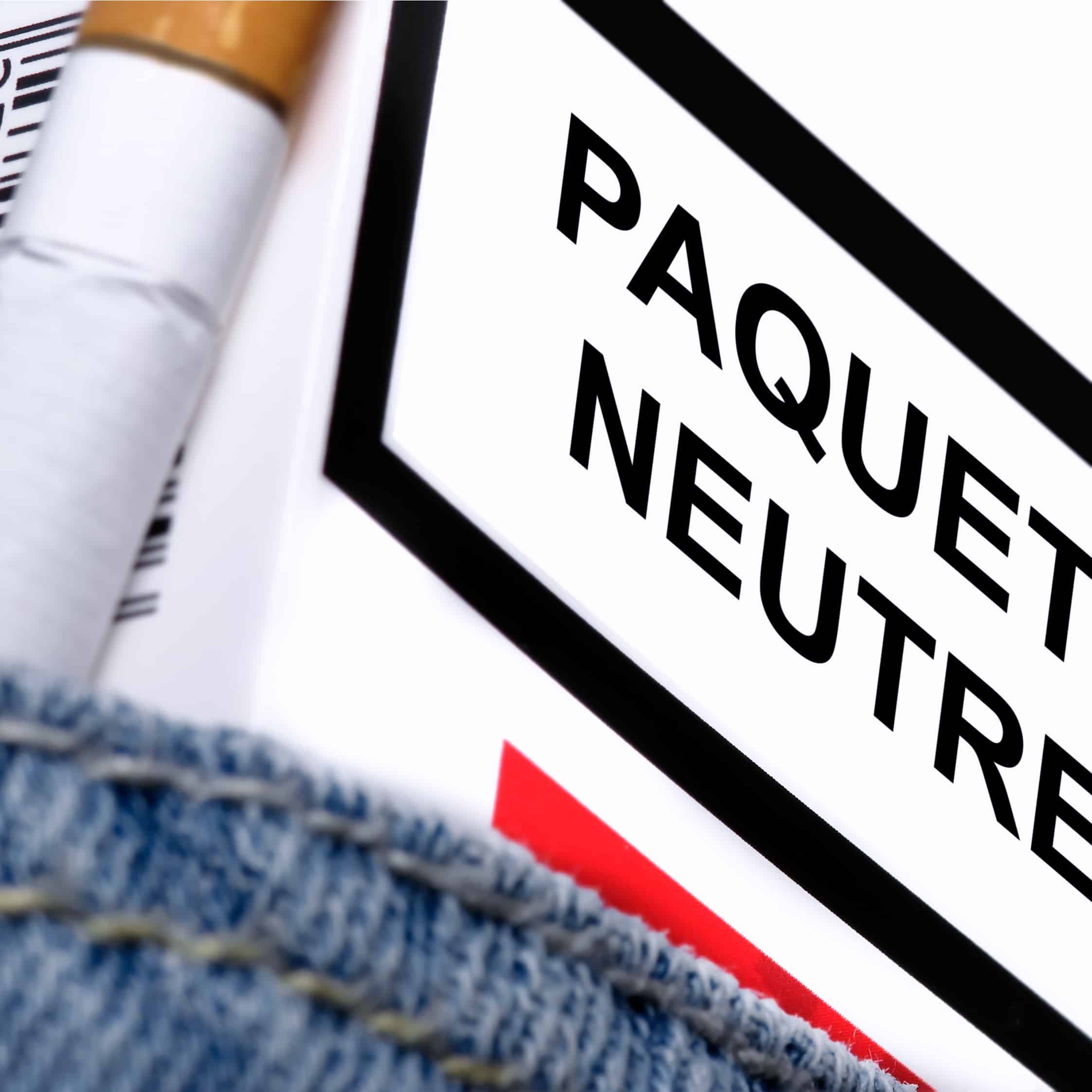
Documents revealed by the daily newspaper El País[1] These figures show that the tobacco industry warned the Spanish government as early as 2024 that it would claim billions of euros in compensation if plain packaging were imposed. The measure has since been withdrawn twice from the legislation put forward by the Ministry of Health, even though it is implemented in some thirty countries and no manufacturer has ever won a case in a national or international court. This sequence illustrates a modus operandi long documented by the World Health Organization: unable to win lawsuits, the industry relies on their deterrent effect to delay the adoption of the measure.
The plain packaging removes logos, colours and distinctive graphic elements of the brand: only the name remains, in standardized typography on a uniform background, with health warnings occupying most of the surface.
A legally unfounded threat of compensation, the amount of which has not been publicly quantified.
The document, uncovered by El País on August 4, 2026, is a previously unpublished 43-page memorandum of observations submitted by Mesa del Tabaco, an organization representing manufacturers, tobacconists, and tobacco growers, in response to a draft royal decree put forward in 2024 by the Spanish Ministry of Health. The document characterizes plain packaging as a large-scale expropriation measure, which its authors argue violates manufacturers' trademark rights and constitutes a disproportionate restriction on freedom of expression. The memorandum adds that no expropriation can take place without corresponding compensation, without specifying an amount. Mesa del Tabaco further argues that uniform packaging would facilitate counterfeiting and illicit trade, and that price competition could lower the cost of cigarettes and increase consumption.
After receiving these observations, the ministry withdrew the provision from the draft decree. Plain packaging was then excluded a second time from the tobacco bill approved by the Council of Ministers on July 21, 2026, despite the initial intention to include it. When questioned by El País, Health Minister Mónica García explained that other ministerial portfolios disagreed with the measure, while expressing confidence in its reintroduction during parliamentary debate. Government sources cited by the newspaper cited the risk of fraud and smuggling as reasons for the exclusion and asserted that pressure from the tobacco industry did not influence this decision. It is worth noting that while the Ministry of Health oversees the health aspects of tobacco regulation, the commercial organization of the market falls under the purview of the Tobacco Market Commission (Comisionado para el Mercado de Tabacos), an autonomous body attached to the Ministry of Finance, whose advisory committee includes representatives from the private sector. In a written response, the employers' federation ADELTA reaffirmed its arguments and indicated that it did not have estimates of possible asset claims, believing that a measure of this scope must be based on a solid legal foundation, be proportionate and be subject to an objective evaluation of its effectiveness.
A systematic dispute that the industry has never won
Plain packaging has its international basis in the guidelines for implementing Articles 11 and 13 of the WHO Framework Convention on Tobacco Control, adopted in November 2008 at the third session of the Conference of the Parties. These guidelines recommend that Parties consider restricting or prohibiting logos, colors, and brand images on packaging, with the exception of the brand name and product name printed in a standardized typeface and color, with health warnings occupying the majority of the surface area. Australia was the first country to transpose this recommendation into national law in 2012, choosing Pantone 448 C, identified by government-commissioned studies as one of the least appealing colors for consumers. France followed in 2016, then the United Kingdom in 2017. Nearly thirty countries now impose this requirement. In 2024, Laos became the twenty-sixth country to legislate on this, and Côte d'Ivoire introduced plain packaging in August 2026, becoming the second African country to implement the measure after Mauritius. No country that adopted it has reverted to branded packaging, and each adoption was accompanied by legal challenges brought by manufacturers, all of which were unsuccessful.
The legal debate rests on a distinction that the decisions rendered have consistently upheld: plain packaging does not infringe upon the existence of trademark rights, but rather regulates their use.1. The trademark holder retains the registration, the distinctive element of the name, and protection against unauthorized use by a third party; only the product presentation methods are restricted, for reasons of public health. Trademark law grants the right to prohibit third parties from using the mark, not a positive and unconditional right to exploit it in any form. It is on this basis that the courts have rejected any claim of expropriation and, consequently, any right to compensation. Furthermore, the regulation of trademark use is not unique to tobacco: it already applies to certain medications.
The amounts brandished by the manufacturers must be interpreted in this light. In Australia, Philip Morris demanded the withdrawal of the measure or the payment of at least US$4.16 billion, according to a legal report on the case, equivalent to approximately €5.3 billion today; in the United Kingdom, an expert report attached to the manufacturer's contribution submitted to the authorities estimated the expected compensation at between £3 billion and £5 billion. These claims, based on a legal classification that the judge did not uphold anywhere, never succeeded. The Australian High Court upheld the 2011 law as early as 2012; the arbitration tribunal seized by Philip Morris Asia on the basis of the bilateral investment treaty between Hong Kong and Australia declared itself incompetent in 2015. The World Trade Organization's panel rejected complaints from Cuba, Honduras, Indonesia and the Dominican Republic in June 2018, a decision upheld on June 9, 2020 by the Appellate Body, which found that the Australian scheme effectively contributed to its public health objective and was no more restrictive to trade than necessary.
France experienced a similar sequence of events. The Constitutional Council upheld Article 27 of the law modernizing our healthcare system on January 21, 2016, and then the Council of State, in its decision of December 23, 2016, rejected all appeals for abuse of power filed by several manufacturers and the National Confederation of Tobacconists against the implementing decrees and orders. The CNCT, which has been advocating for this measure since 1995, has documented the lobbying efforts undertaken beforehand: challenges to the measure's effectiveness, invocation of trademark law accompanied by claims for compensation publicly estimated at several billion euros, raising concerns about the risk of smuggling and job losses, calls for a moratorium relayed by tobacconists on the grounds that France should not get ahead of its European partners, and mobilization of third-party organizations in the industrial property and communications sectors. The association points out that the influence exerted during the negotiations of the 2014 directive on tobacco products had already made it possible to rule out a generalization of plain packaging at the European Union level.
It is precisely this gap between the outcome of the procedures and their political impact that the WHO identified in a 2021 document, pointing to industry opposition, including the potential deterrent effect of national and international litigation, as a likely explanation for the low number of countries that have taken this step. The intensity of this opposition contrasts with the robustness of the available data on the effects of the measure and is largely explained by it.
Effectiveness established by available evaluations
The official evaluation conducted by the Australian government concluded that there was a statistically significant decrease in smoking prevalence of 0.55 percentage points over the three years following implementation, compared to the counterfactual scenario without reform, representing approximately 108,000 fewer smokers. A Cochrane Collaboration review of 51 studies and nearly 800,000 participants established that standardized packaging reduces the visual appeal of products and mitigates the misconception that some cigarettes are less harmful than others. The WHO identifies three mechanisms of action: removing packaging as an advertising medium, eliminating misleading information about the relative harm of products, and improving the visibility of health warnings, specifying that the measure can only be effective when integrated into a comprehensive tobacco control strategy.
Armando Peruga, from the tobacco unit at the Catalan Institute of Oncology and former head of the WHO's Tobacco-Free World initiative, points out that the primary objective is not immediate cessation but rather reducing the initiation of tobacco use by younger generations. He also emphasizes that the argument of smuggling, one of the most studied, is not supported by data collected in countries that have implemented the measure. The economic benefits announced by the industry have also failed to materialize: analyses produced by the sector focus on losses in certain segments without considering the reallocation of these freed-up expenditures to other areas of consumption.
Reacting to the Spanish revelations on August 7, 2026, Smita Baruah, Executive Vice President for Global Tobacco Control at the Campaign for Tobacco-Free Kids, stated that Spain should continue implementing plain packaging, bearing in mind that tobacco companies have lost every legal challenge against the measure, and that governments must stand firm against industry interference. The fate of the measure now depends on parliamentary decisions in the Congress of Deputies.
AE
[1] Oriol Güell, Tobacco products are delivered to the tobacco with multi-million dollar compensation if approved in generic packaging, El País, published on August 4, 2026, accessed on August 10, 2026
National Committee Against Smoking |