Vaping on the rise among French high school students
May 1, 2026
Par: National Committee Against Smoking
Dernière mise à jour: April 30, 2026
Temps de lecture: 5 minutes
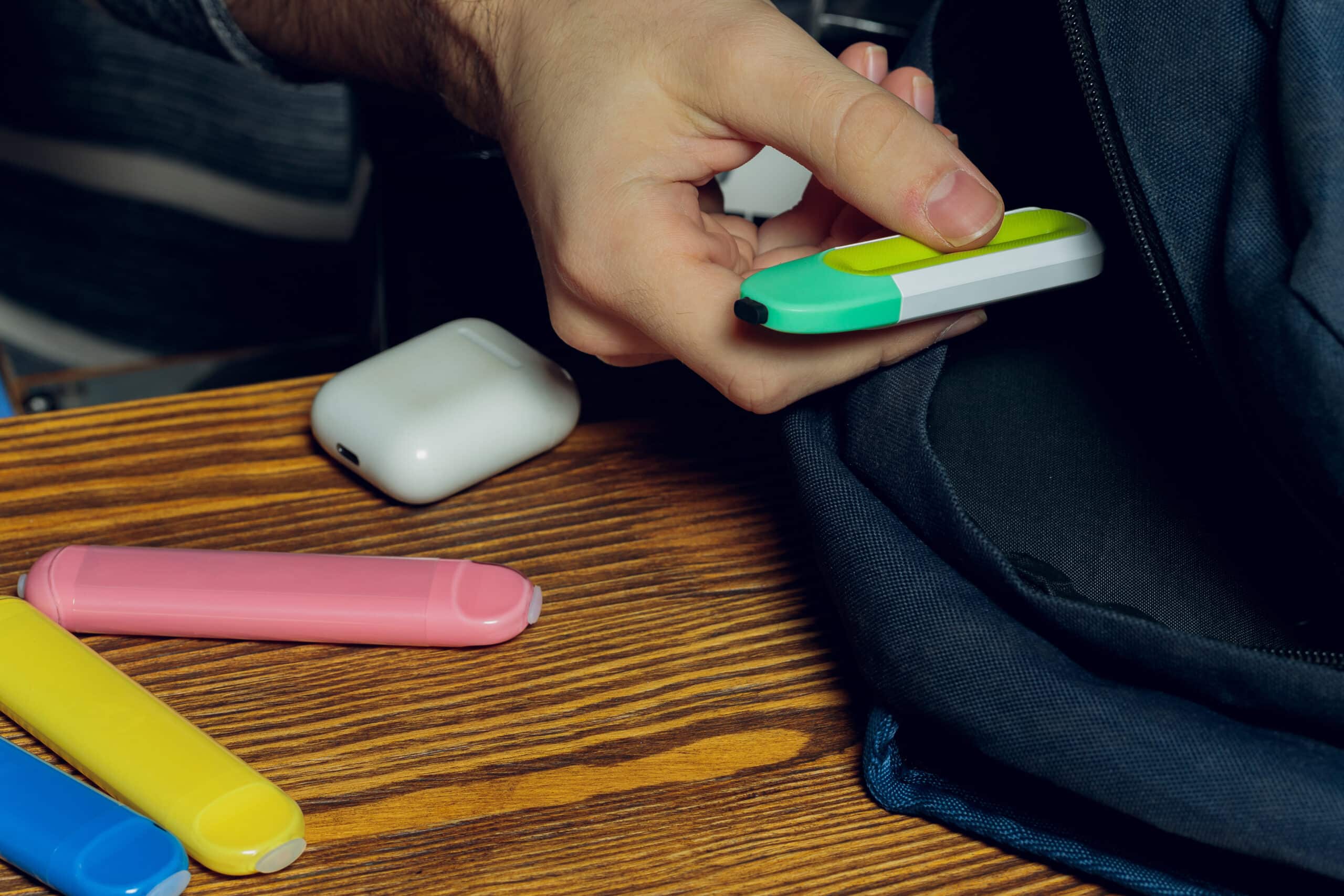
The French Monitoring Centre for Drugs and Drug Addiction (OFDT) has published data on the evolution of electronic cigarette use among secondary school students between 2014 and 2024, including disposable models which are now banned.[1]. The EnCLASS 2024 survey, conducted among 11,731 students in metropolitan France between March and June 2024, compares these practices among high school students in general and technological high schools versus vocational high schools and presents the dual uses of e-cigarettes and traditional cigarettes. The survey indicates that while experimentation with e-cigarettes is decreasing among middle school students, experimentation and daily use are increasing among high school students, especially among girls and those in vocational high schools. E-cigarettes are also increasingly being used before or in addition to smoking a traditional cigarette.
A decrease in vaping among middle school students, an increase among high school students, with significant social disparities
Between 2014 and 2024, experimentation with e-cigarettes declined among middle school students (from 26.8 per 100,000 to 19 per 100,000), while it increased sharply among high school students (from 35.1 per 100,000 to 46 per 100,000), slightly higher than the European average for high schools in 2024 (44 per 100,000). This increase was more pronounced among girls (48.7 per 100,000) than boys (43.2 per 100,000), and particularly in vocational high schools: between 2015 and 2024, the proportion of high school students who had experimented with e-cigarettes rose from 34.2 per 100,000 to 41.5 per 100,000 in general and technological education institutions, but from 36.8 per 100,000 to 58.7 per 100,000 in vocational high schools.
Daily e-cigarette use among high school students is projected to increase from 2.8 per 100,000 in 2018 to 6.8 per 100,000 in 2024, with similar increases for both boys and girls. Significant differences also exist depending on the type of school: 11.1 per 100,000 in vocational high schools compared to 5.3 per 100,000 in general and technological high schools.
The experimentation with disposable electronic cigarettes or "puffs," which have been widely distributed since September 2021 and banned in February 2025, involved 16.6 % of middle school students and 39.4 % of high school students in 2024. They represented the entry point for electronic cigarette experimentation for 87.5 % of middle school students and 85.5 % of high school students.
Vaping is increasingly becoming the gateway to nicotine addiction.
While vaping products were previously used primarily by smokers, today a growing proportion of young people are becoming addicted to nicotine directly through this product without having previously smoked tobacco. It has been observed that high school students who have experimented with both traditional cigarettes and e-cigarettes were more likely to have tried e-cigarettes first in 2024 (39.6% of students) than in 2018 (28.9% of students), suggesting that vaping products can act as a gateway to tobacco use. In 2024, 48.1% of high school students had already experimented with tobacco cigarettes and/or e-cigarettes, 9.5% reported daily use of tobacco cigarettes and/or e-cigarettes, and among them, 2.6% used both daily.
However, 4 % of high school students report exclusive daily use of electronic cigarettes compared to 0.8 % in 2018, while daily smoking alone falls from 15.5 % of high school students in 2018 to 2.9 % in 2024.
The OFDT highlights the role of aggressive marketing in this development
The investigation adds that behind this spread of e-cigarettes lies the issue of increasingly aggressive marketing, particularly online, targeting younger audiences. This reality has been especially highlighted by the phenomenon of "puffs," but also by the presence of sweet and fruity flavors in these products and the development of colorful and attractive packaging, normalizing this consumption. Adding to this observation of the spread of e-cigarettes among teenagers is the emergence of new nicotine products such as nicotine pouches, the experimentation with which is also increasing among high school students, often in conjunction with e-cigarette use. This is happening in defiance of French law, which recently reaffirmed that Nicotine sachets have never been legal on national territory.
Faced with the risk of a nicotine epidemic among young people, which fosters early and lasting addiction, public health experts support protective regulations for vaping products. They also call for vigilance regarding compliance with the ban on the marketing of any other new nicotine products. For example, the National Committee Against Smoking (CNCT) and the Contre-Feu alliance recently expressed their support for a cross-party bill to extend plain packaging to all tobacco and vaping products. Included in the National Tobacco Control Program (2023-2027), this measure aims to limit the use of packaging for promotional purposes. The CNCT (National Committee Against Tobacco) has also called for a ban on the online sale of vaping products, the elimination of the advertising exemption at points of sale for all tobacco and vaping products, the removal of attractive flavors, and stricter controls and penalties for sellers who do not comply with their legal obligations.[2].
AD
[1]Spilka S., Philippon A., Le Nézet O., Janssen E., Trends in vaping among middle and high school students between 2014 and 2024. EnCLASS 2024 results, Trends No. 172, OFDT, 4 pp., published in April 2026, accessed on April 29, 2026
[2]Vaping: the CNCT calls for neutral packaging and a ban on online sales, National Committee Against Smoking, published on February 19, 2026, accessed on April 29, 2026