Plastic Treaty: CNCT and Surfrider Europe call for the elimination of cigarette filters
August 2, 2025
Par: National Committee Against Smoking
Dernière mise à jour: August 1, 2025
Temps de lecture: 6 minutes
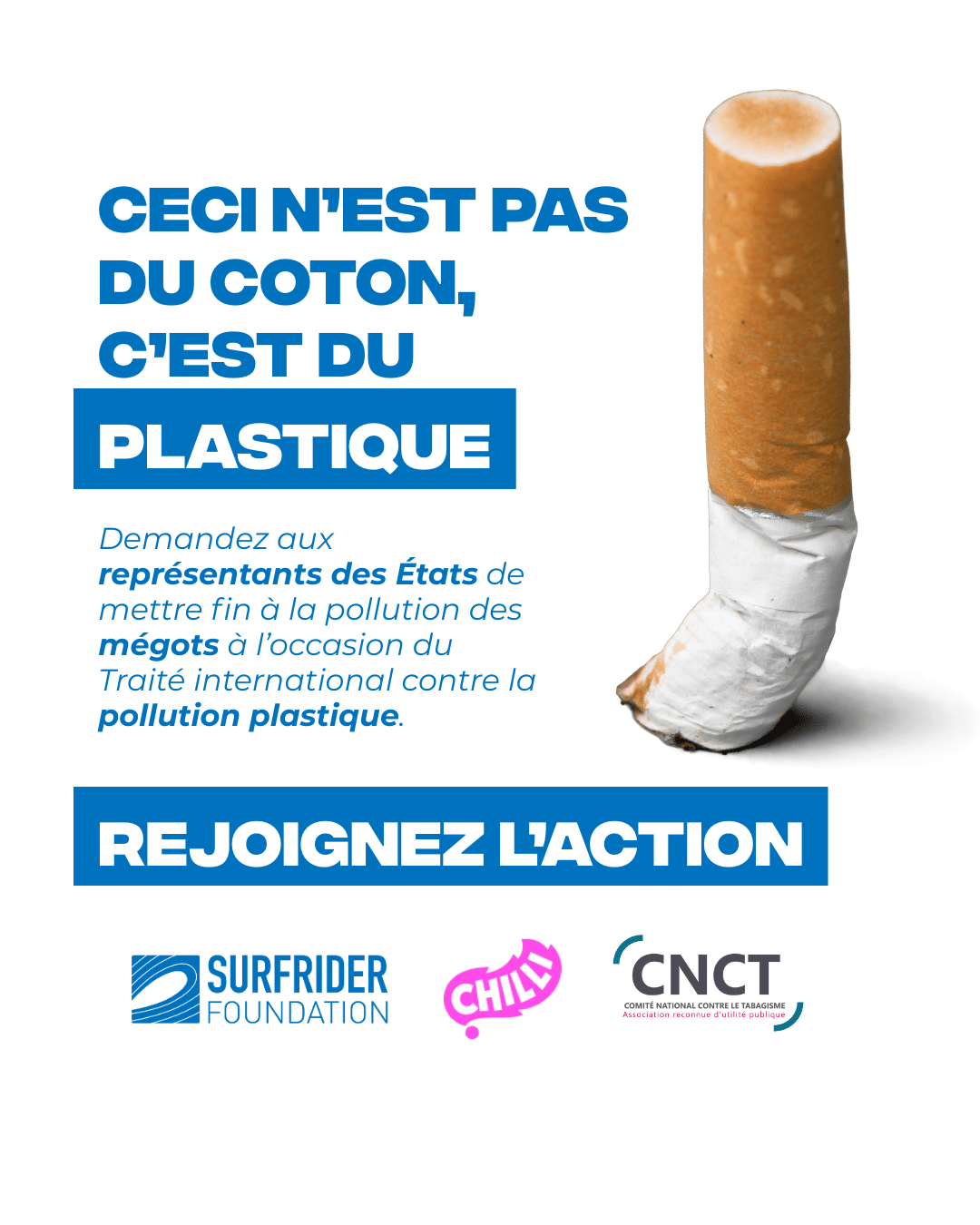
On the occasion of the fifth session of the international negotiations on plastic pollution (INC-5.2), which will be held in Geneva from August 5 to 14, the National Committee Against Tobacco (CNCT) and Surfrider Foundation Europe are calling for a ban on cigarette filters in the future global treaty. Supported by the Stop Tobacco Pollution Alliance (STPA), they are warning of the environmental and health dangers of this toxic plastic waste and the false solutions promoted by the tobacco industry.[1].
Surfrider Foundation Europe is supporting these recommendations with a digital citizen mobilization campaign. Through the platform Chile, European citizens are invited to appeal to their national representatives to encourage them to support the ban on cigarette filters in the treaty. This approach aims to strengthen democratic pressure on the Member States of the European Union, in a context where political arbitrations will be decisive for the robustness of the measures adopted.
Cigarette filters: a toxic and ubiquitous plastic waste
Each year, more than 4.5 trillion cigarette filters are discarded into the environment. This figure makes cigarette butts the world's largest plastic waste product in terms of number of units. Composed of cellulose acetate, a polymer derived from plastic, these filters are not biodegradable. When exposed to the elements, they fragment into persistent microplastics, while releasing more than 40 toxic substances into the environment, including heavy metals, polycyclic aromatic hydrocarbons, and residual nicotine.
The impacts on aquatic ecosystems are documented: a single cigarette butt can contaminate up to 1,000 liters of water, and several studies demonstrate lethal effects on marine wildlife exposed to these residues. Despite their ubiquity, cigarette filters offer no proven health benefits for smokers. Their sole function is marketing: to maintain the illusion of a less harmful product, which contributes to the persistence of smoking.
Cigarette butt recycling: a technical, environmental and political impasse
Faced with growing calls to ban filters, the tobacco industry is promoting recycling systems that fail to withstand scrutiny. Existing processes, still very marginal, are technically complex, extremely energy-intensive, and poorly suited to the contexts of low- and middle-income countries. Furthermore, the products produced by these processes have uncontrolled residual toxicity and marginal added value.
These initiatives foster the idea of a viable technological solution, while they primarily contribute to the industry's "environmental legitimacy" strategy. The French Extended Producer Responsibility (EPR) system, implemented through the eco-organization Alcome, is a concrete illustration of this: financed and governed by manufacturers, this system focuses its actions on collection and awareness-raising, without any real constraints on product design or the objective of source reduction. By giving industry an active role in managing its own pollution, this model contravenes the fundamental principles of public health and prevention.
“Biodegradable” filters: an illusory solution with harmful effects
More and more tobacco industry players are promoting so-called "biodegradable" filters as an environmentally friendly alternative to traditional plastic filters. However, these products do not decompose naturally in the environment, absent specific industrial conditions. They also continue to release the same toxic substances as traditional filters.
By reinforcing the illusion of a "cleaner" cigarette, these filters contribute to trivializing the act of throwing cigarettes in public spaces and to maintaining erroneous perceptions about the product's dangerousness. Their marketing constitutes an environmental misinformation strategy that complicates the implementation of source reduction policies.
Recommendations aligned with health and environmental commitments
As part of the INC-5.2 negotiations, the CNCT, Surfrider Foundation Europe, and the STPA coalition are calling for the adoption of clear and binding provisions to include cigarette filters among the products to be eliminated at source in the future global treaty. These recommendations include:
- The explicit inclusion of filters in Annex Y of the treaty, without restriction on their plastic composition;
- The rejection of all substitution or recycling measures presented as “solutions” by the industry;
- The inclusion of a legal compatibility clause between the plastic treaty and the WHO Framework Convention on Tobacco Control (FCTC), to ensure consistency with existing international public health commitments.
This articulation between health and environmental objectives is essential to prevent conflicts of interpretation and ensure the exclusion of industrial actors from decision-making processes. The future treaty represents a unique opportunity to eliminate avoidable, toxic, and socially useless waste.
Negotiations under pressure: the growing influence of industrial lobbies
The INC-5.2 session opens in a climate of heightened mistrust regarding the growing influence of industries affected by the treaty. According to a recent survey published by The Guardian[2], more than 190 representatives from the plastics, oil and tobacco sectors were granted official access to the previous round of negotiations, a number greater than that of many state delegations.
This situation compromises the integrity of the discussions and highlights the ability of these industries to influence the wording of the treaty's articles, particularly by insisting on technical or voluntary approaches with little stringent requirements. NGOs involved in environmental and public health advocacy warn of the risks of weakening the final text if these pressures are not countered by rigorous governance based on scientific evidence.
In this context, the call to include a compatibility clause with the FCTC takes on a strategic dimension: it would make it possible to limit industrial access to the negotiations and preserve the ambition of the treaty in the face of attempts at interference.
AE
[1] Press release, At INC-5.2, CNCT and Surfrider advocate for a global ban on cigarette filters, CNCT, published on August 1, 2025, consulted the same day
[2] Damian Carrington, 'Total infiltration': How plastics industry swamped vital global treaty talks, The Guardian, published July 23, 2025, accessed August 1, 2025
National Committee Against Smoking |