Parallel markets: the CNCT dismantles the tobacco industry's arguments
November 12, 2025
Par: National Committee Against Smoking
Dernière mise à jour: November 12, 2025
Temps de lecture: 6 minutes
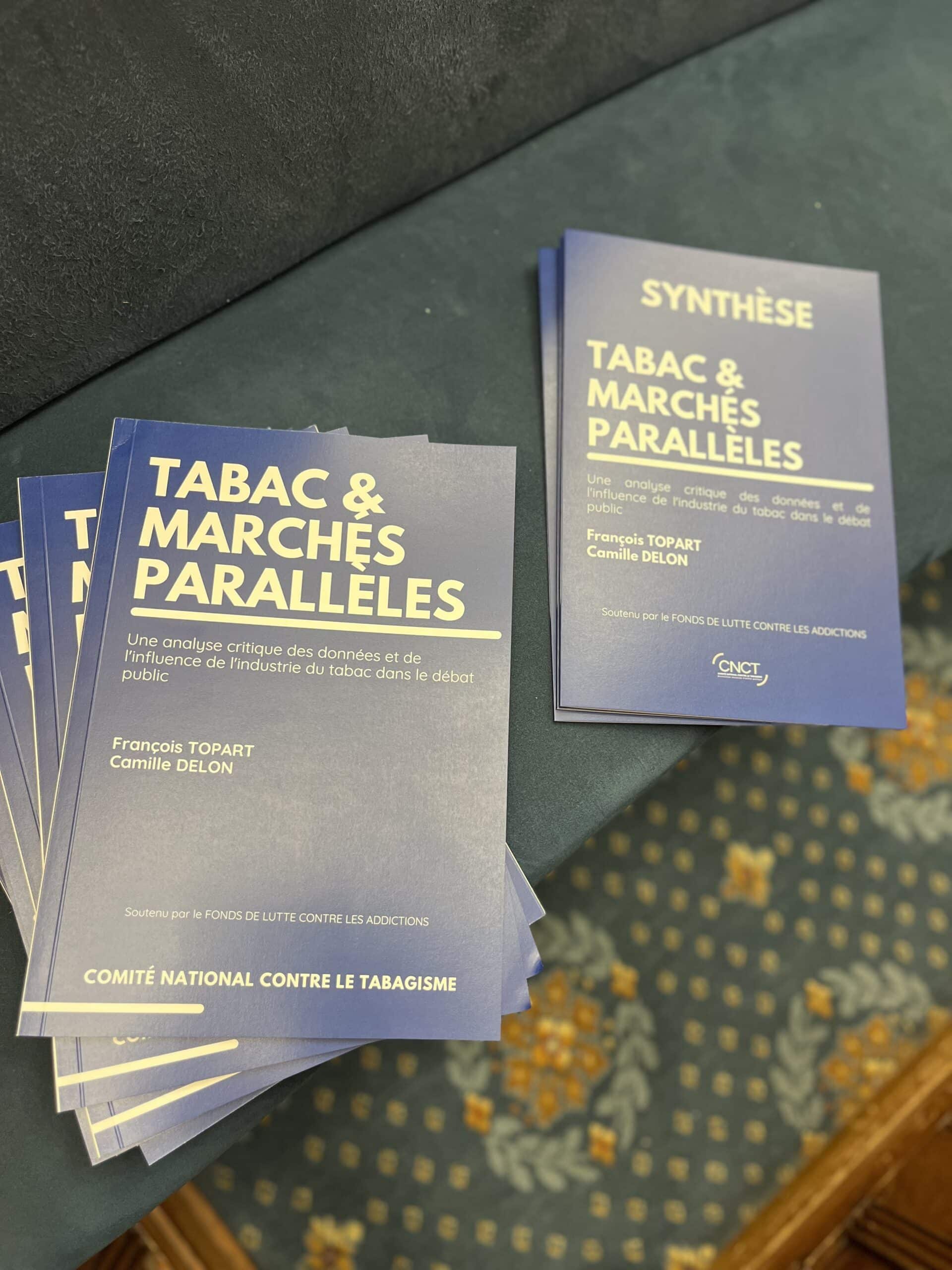
On October 23, 2025, the National Committee Against Smoking (CNCT) organized a symposium at the National Assembly on parallel tobacco markets, their scope, their challenges and the solutions to be implemented in the face of disinformation orchestrated by the tobacco industry. This organization is striving to influence public debate to curb tax increases and divert attention from its responsibility in off-network sales. At this conference, the CNCT presented the 5.3 Awards, recognizing public, political, and citizen initiatives working towards a tobacco-free society free from lobbying influence. These awards underscore the importance of Article 5.3 of the WHO Framework Convention on Tobacco Control (FCTC), which requires states to protect their public health policies from any interference by the tobacco industry.
The tobacco industry's study on parallel markets contradicted by an independent study
An independent study by Christian Ben Lakhdar, professor of economics at the University of Lille, funded by the DGDDI and the MILDECA, In particular, it assessed the share of tobacco consumed in France that escapes national taxation (TAFE), the associated tax losses and the profiles of the consumers concerned.
The analysis combined delivery data (2016-2023), representative surveys, and statistical simulations. The gaps between delivered and consumed volumes, or Tax Gaps, are used to estimate the Total Taxable Tobacco Expense (TAFE) by region: in 2023, the TAFE was estimated to be between 12 and 22 of the national consumption (approximately 8,000 tonnes), representing an average tax shortfall of €4.3 billion. Cross-border purchases (6,863 tonnes of tobacco, 15 of the total purchases) constitute the main source of tax revenue shortfall, far surpassing illegal purchases (366 tonnes, 0.8 of the total purchases), which are nevertheless constantly criticized by the industry.
Contrary to the ideas promoted by the tobacco industry, which portrays the off-network tobacco buyer as a middle- or low-income individual supposedly "victimized" by public health policies (tax increases, plain packaging for cigarettes, etc.), "off-network tobacco buyers" are often young, urban individuals with relatively high incomes. Research conducted by independent scientists shows that the main issue in the parallel market in France lies in cross-border purchases, not in counterfeiting, smuggling, or street vending.
They thus point to the largely overestimated estimates disseminated by the tobacco industry, often repeated without critical examination by some political decision-makers.
A second independent study analyzes industry interference in political and media discourse
Research by François Topart, head of studies at CNCT, has highlighted the influence of the tobacco industry on the public and parliamentary debate surrounding parallel markets, particularly through the media and amendments tabled in the National Assembly.
The analysis was based on 2,754 articles from regional and national daily newspapers (2020-2025) and 229 amendments from members of parliament, as well as a critical review of the KPMG report funded by the tobacco industry. It revealed that 55 of the articles primarily reiterate industry figures, including those from the KPMG report, which erroneously estimates illegal consumption at 37.6% in 2024. In the National Assembly, more than 30 of the amendments originate from the tobacco sector, often tabled by a few elected officials. 94 of these amendments link parallel markets to tax increases and oppose anti-tobacco tax policies.
The study calls for greater transparency on the origin of amendments and the adoption of public measures based on independent data.
Provisions exist to combat parallel markets but need to be implemented
Finally, during this symposium, the question of the tobacco industry's responsibility in the development of these parallel markets was addressed.
Based on Article 15 of the UNFCCC, a protocol to eliminate illicit trade in tobacco products was adopted in 2012 and entered into force in 2018. It provides for a traceability and tracking system (TSS) that is completely independent of the tobacco industry. The European Union implemented its own TSS in 2019 for cigarettes and roll-your-own tobacco, which will be extended to all tobacco products in 2024.
However, Luk Joossens, a consultant with Smokefree Partnership and an expert on the illicit tobacco trade, points out that this system does not comply with the WHO Protocol. He notes that its independence is not guaranteed, that the data—more than 112 billion unique identifiers—remains inaccessible, and that no audit report has yet been made public. He therefore advocates for a reform of the European traceability system to ensure truly independent governance and complete transparency in audits.
Furthermore, he also points out that at the international level, the global information exchange platform suffers from a lack of resources and remains inactive due to technical and financial needs.
A call to respect the Protocol to Combat Illicit Trade, put forward by the CNCT
Emmanuelle Béguinot, director of the National Committee Against Smoking, emphasizes that effective control of the supply chain also involves limiting deliveries of tobacco products in each country, adjusting them to the prevalence of smoking and actual levels of consumption.
Indeed, these cross-border purchases are made possible because tobacco manufacturers deliberately oversupply tobacconists located at the borders. Thus, in Luxembourg, if the quantity delivered were to be compared to the country's tobacco consumption, each Luxembourger (including non-smokers) would have to smoke more than 21 cigarettes per day.
This provision is notably supported by French parliamentarians, including Frédéric Valletoux, who has already submitted a bill and a resolution to this effect. It is one of the obligations of the Protocol to Combat Illicit Trade in Tobacco Products, ratified by France and the European Union. According to Emmanuelle Béguinot, these commitments must be respected.
She insists that in order for France to make its voice heard and to put forward these strong proposals, it would however have to fulfill its contributions as a Party to the WHO Protocol to eliminate the illicit trade in tobacco products.
AD
National Committee Against Smoking |