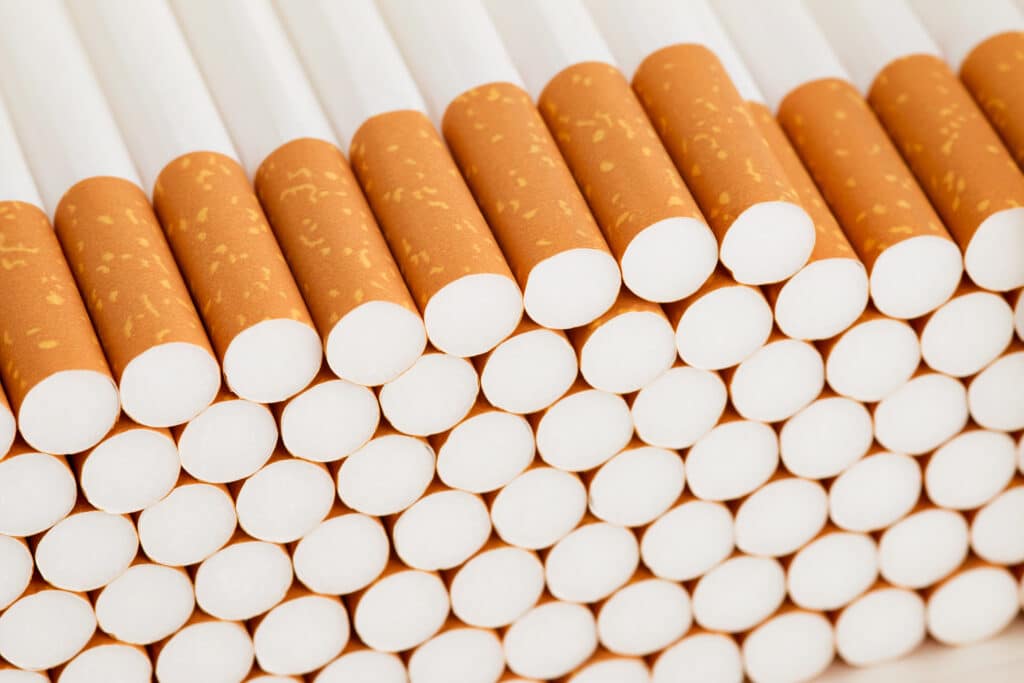
Philip Morris France invited by the Auvergne-Rhône-Alpes Regional Council to discuss the illicit cigarette trade
September 30, 2022
Par: National Committee Against Smoking
Dernière mise à jour: September 30, 2022
Temps de lecture: 5 minutes

Local environmentalist elected officials denounced the hearing of the head of the department for the prevention of illicit trade at Philip Morris France by the Security Commission of the Auvergne-Rhône-Alpes Regional Council on September 22. The hearing took place despite these protests, in contradiction with the obligation to protect public policies from the tobacco lobby.
It was upon receiving the summons from the Security Committee that the Green elected representatives of the Auvergne-Rhône-Alpes Regional Council discovered that a hearing of Daniel Bruquel, head of the Prevention of Illicit Trade department at Philip Morris France (PMF), was to take place two days later, on September 22, 2022.
In a statement, they regretted this step and recalled that "The United Nations General Assembly has recognized that there is 'a fundamental conflict of interest between the tobacco industry and public health.'"[1] They also highlighted Philip Morris' involvement in the development of smoking, and pointed out its role in smuggling and its Codentify traceability system, denounced by the World Health Organization (WHO).
Instrumentalization of illicit trade by the tobacco industry
"What's next? Nestlé on the Environment Committee? Coca-Cola on the Health Committee?" Enzo Poultreniez, secretary general of the Ecologists group in the region, was indignant, according to whom this hearing was due to the fact that Daniel Bruquel was "quoted in a recent report from Le Progrès", on the subject of cigarette trafficking in the Guillotière district of Lyon[2]. Like many other press articles, this one repeated the discourse of the tobacco industry, which overestimates the proportion of illicit trade in France by relying on the contested studies produced by the KPMG firm.[3]. The reliability of studies of KPMG on illicit trade may indeed seem light when their authors declare that they do not "having sought to establish the reliability of the sources of information".
This overestimation of the clandestine market, and more particularly of the counterfeit market, appears to be one of the tobacco industry's techniques to counter increases in the price of tobacco products and to halt the fall in cigarette sales. Independent studies have, on the contrary, shown that anti-smoking measures and a high level of tobacco taxation tend to reduce or stabilise the share of illicit trade, both at national and international levels.[4]. Significant increases in tobacco excise duties are also considered one of the most effective tools for reducing smoking prevalence.[5].
A lack of awareness of Article 5.3 of the FCTC
The approach that raises more questions is that of the Auvergne-Rhône-Alpes Regional Council with regard to the tobacco industry. It demonstrates, at the very least, a lack of knowledge of Article 5.3 of the WHO Framework Convention on Tobacco Control (FCTC), according to which public policies should not be "influenced by the commercial and other interests of the tobacco industry"[6]. Specific implementing guidelines for this obligation provide in particular that relations between public authorities and representatives of the tobacco industry must be limited to what is strictly necessary for the regulation of tobacco products and its industry and, where such interactions exist, they must take place transparently.
As also recalled by the regional ecologist elected representatives, the member states of the World Health Organization (WHO) have also established that "WHO does not collaborate with the tobacco industry or with non-state actors that defend its interests"[7]. A principle that can be applied to each of these members, and must also be extended to regional councils.
Keywords: illicit trade, Philip Morris, Regional Council, Auvergne-Rhône-Alpes region ©Generation Without TobaccoMF
[1] Philip Morris invited to the regional council: victims of the tobacco lobby will appreciate it!, The Ecologists, press release of September 21, 2022, consulted on September 27, 2022. [2] Jaumouillé N, Philip Morris invited to the regional council: the Ecologists are up in arms, Lyon Capitale, published on September 22, 2022, consulted on September 27, 2022. [3] Fighting the illicit tobacco trade in France, CNCT, published June 14, 2022, consulted September 27, 2022. [4] Paraje G, Stoklosa M, Blecher E, Illicit trade in tobacco products: recent trends and emerging challenges, Tobacco Control, 2022;31:257–262. [5] US National Cancer Institute and World Health Organization. The economics of tobacco and tobacco control. National Cancer Institute Tobacco Control Monograph 21. US Department of Health and Human Services, National Institutes of Health, National Cancer Institute and World Health Organization, 2016. [6] Framework Convention on Tobacco Control, WHO, 2004. [7] World Health Assembly Resolution, Framework for Engagement with Non-State Actors, WHA69.10, May 28, 2016, paragraph 44. National Committee Against Smoking |