
China Tobacco, the new tobacco giant
June 30, 2021
Par: National Committee Against Smoking
Dernière mise à jour: August 6, 2024
Temps de lecture: 12 minutes
Summary
- China Tobacco, a Chinese monopoly
- China Tobacco's Ties to the Chinese Government
- The structuring of China Tobacco
- What is the difference with other tobacco multinationals?
- The profitability of the CNTC
- China Tobacco Sales Worldwide
- What regulations for China Tobacco?
- A little-known behemoth
China Tobacco, a Chinese monopoly
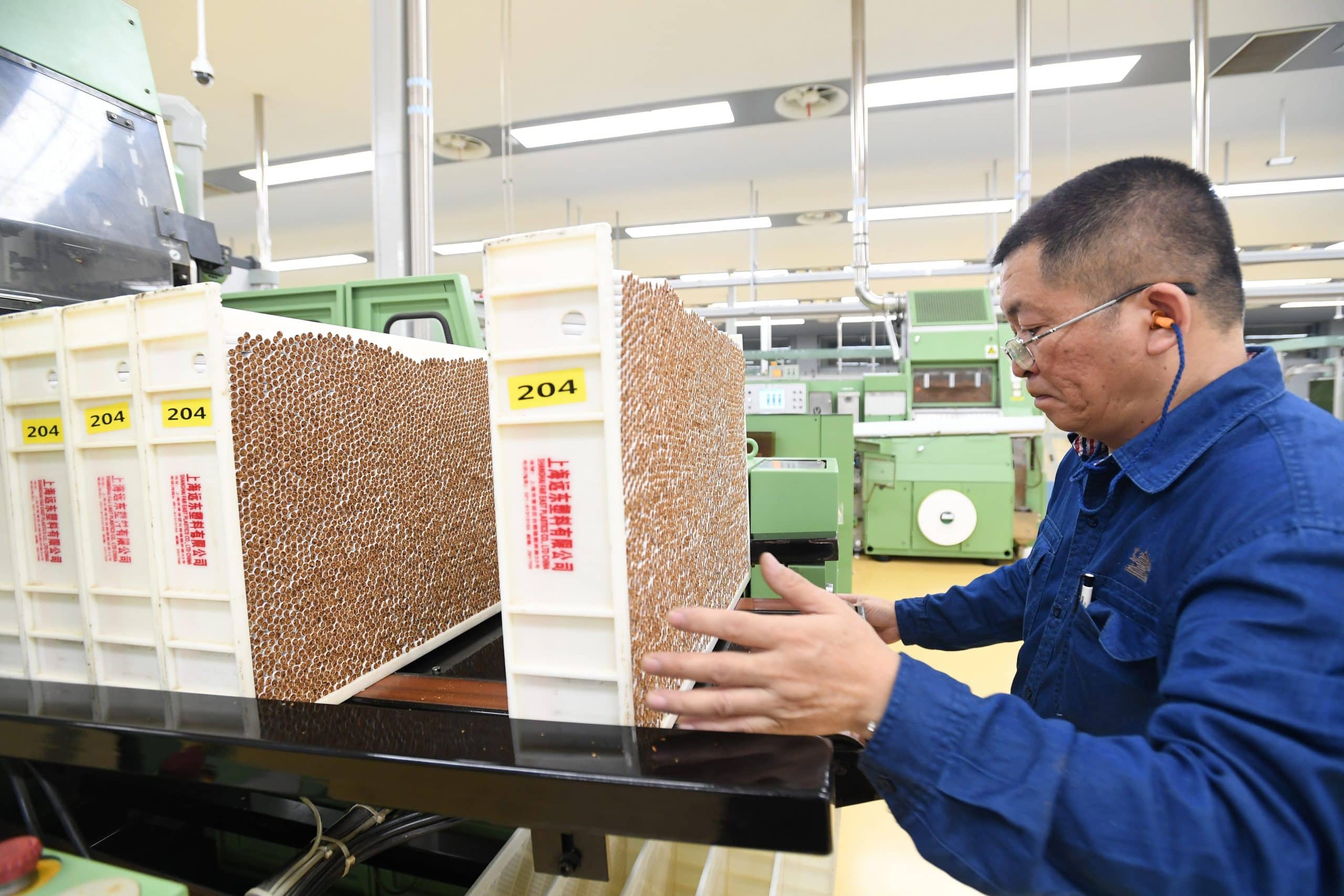
China National Tobacco Corporation, also known as China Tobacco or CNTC, is a state-owned tobacco company in China. Founded in 1982, it is by far the largest tobacco company in the world, accounting for between 43.6% and 45% of global cigarette sales. China Tobacco has a monopoly on the entire industrial process, from growing, purchasing, manufacturing, and distributing tobacco products. CNTC alone produces more cigarettes than the four tobacco multinationals: Philip Morris International (PMI), British American Tobacco (BAT), Japan Tobacco International (JTI), and Imperial Brands.
Until recently, the CNTC had focused on selling tobacco in the Chinese domestic market. As the world's most populous country, China is also one of the largest markets for tobacco products. With over 300 million smokers, China consumes one in three cigarettes produced worldwide.
In 2003, CNTC launched the "Go Global" strategy, aiming to export large quantities of tobacco around the world. This turnaround was aimed at responding to the company's declining revenues domestically, due to increased competition from abroad, combined with the reduction in the number of smokers in China. In the same year, the World Health Organization Framework Convention on Tobacco Control was signed by WHO member countries, constituting the first international public health treaty, and a historic step towards international awareness and structuring of tobacco control.
In 2019, China Tobacco's business expanded to twenty countries, operating through 34 overseas facilities (sales offices, manufacturing plants, specialized supply companies). In an article titled: " China National Tobacco Corporation: From National Dragon to Global Dragon? ", researchers point out that the expansion of the Chinese monopoly, if it continues on its current trajectory, could result in "profound impacts on public health." For the authors of the study: "the Chinese industry is advantaged by its size, weak domestic regulation and government support for overseas expansion […] If successful, this will lead to increased global price competition, the emergence of new products and intensified marketing, all leading to increased tobacco consumption."
China Tobacco's Ties to the Chinese Government
CNTC is regulated by the State Tobacco Monopoly Administration (STMA), the main government agency that administers the tobacco industry in China. Since 2008, STMA has been controlled by China's Ministry of Industry and Information Technology. Although STMA nominally oversees CNTC, they are in reality one and the same organization, sharing the same structure, employees and management, and website.
The STMA, in collaboration with the CNTC, determines the general policy of the Chinese government on tobacco, including setting production quotas and product prices. The CNTC is then responsible for implementing the jointly established roadmap.
In 2013, China embarked on a policy called the Belt and Road Initiative (BRI), which is a strategy aimed at building infrastructure and increasing the country's influence around the world. In 2015, as a state-owned enterprise, CNTC publicly announced that it was joining the national effort. At that time, China Tobacco CEO Ling Chengxing said that the Belt and Road Initiative would accelerate CNTC's global ambitions, and that it should be made to "catch up with the three largest tobacco multinationals."
The structuring of China Tobacco
In the late 1990s, a major reform consolidated this particularly sprawling national industry, which then had up to 185 regional companies, all reporting to the CNTC. For one of the researchers behind the study cited above, "being a state bureaucracy has a direct impact on its structure", "with operational offices at all decision-making levels (municipal, provincial, national)".
Today, CNTC is a particularly large and complex structure, broken down into some thirty small subsidiaries. Some of them operate semi-autonomously, producing their own brands of cigarettes and even participating in joint ventures abroad. For example, CNTC's only European branch - a company in Romania that is playing a major role in its global expansion efforts - is actually controlled by one of its subsidiaries: China Tobacco Anhui Industrial Co., based in Anhui province in eastern China. The rest of its shares are divided between two other CNTC subsidiaries, China Tobacco Shaanxi Industrial Co. and Hongta Tobacco Group Co. Ltd.
What is the difference with other tobacco multinationals?
The main difference between China Tobacco and the tobacco multinationals is that CNTC is fully state-owned. However, state monopoly is not a rare phenomenon in Asia: Thailand, South Korea and Vietnam have all been, or still are, state monopolies. In France, SEITA was also a state monopoly for a long time. However, the Chinese state monopoly is of a unique nature.
Indeed, the CNTC’s ties to the state create a significant conflict of interest, as the Chinese government owns and regulates the company. Yet, having ratified the FCTC in October 2005, China is at the same time required to put in place a regulatory framework to limit tobacco consumption. The Chinese situation is particularly contradictory, since responsibility for implementing the Convention falls even to the STMA, which also controls and sets the roadmap for the CNTC. In 2012, an article in the journal Tobacco Control pointed out that “these dual responsibilities raise serious questions about the organization of tobacco control authorities, and whether their structural prerogatives hamper their ability to protect consumers.” Since the CNTC is not subject to shareholders, it is not required to disclose information about its activities. In this respect, apart from announcing colossal profits, China Tobacco does not do this.
However, in 2019, CNTC launched its first listed subsidiary, China Tobacco International (CTI), listed on the Hong Kong Stock Exchange. CTI Hong Kong describes itself as the ideal offshore platform for China Tobacco’s international business expansion. CTI now handles CNTC’s tobacco leaf sales worldwide, as well as cigarette sales in some Southeast Asian markets. According to OCCRP, the China Tobacco subsidiary will also lead the state monopoly in selling its own heated tobacco products.
The profitability of the CNTC
At present, it is impossible to know precisely the turnover or profits made by the CNTC. Although the structure occasionally communicates its annual profits, the data remains controlled by the government and, unlike other large tobacco companies, these figures are not subject to independent audit.
To date, the most recent financial information available is from 2019, when the China Tobacco Control Supervision announced that the total industrial and commercial profits of the tobacco industry in China amounted to 1.20 trillion yuan for the past year, or more than 140 billion euros.
China Tobacco Sales Worldwide
According to United Nations figures, China now exports its products to 125 countries, and on five continents. However, it is difficult to know exactly where all these products end up. Indeed, OCCRP journalists have uncovered numerous examples where CNTC or its subsidiaries supplied cigarettes to countries where there was no legal market for them, such as Latin America, Europe, and Ukraine in particular.
The reporters spoke to tobacco control experts in several countries who said they had never observed Chinese cigarette brands on the legal market, despite export records. For example, China reported exporting 6,246 tonnes of cigarettes to Canada, worth €135.88 million, between 2010 and 2019. Robert Cunningham, a senior policy analyst for the Canadian Cancer Society, said he knew of only one place where these cigarettes were legally sold: at a customs shop at Vancouver International Airport.
When China Tobacco brands are sold legally, they are often in duty-free shops, such as Vancouver. However, CNTC tobacco products appear on the black market in countries around the world, including Ukraine, Romania, Italy, Australia, Colombia and the Philippines.
What regulations for China Tobacco?
In October 2005, China ratified the Framework Convention on Tobacco Control (FCTC), a legally binding international treaty of the World Health Organization to regulate and curb tobacco use. As such, China must implement a number of public health policies to reduce tobacco use, while protecting itself from the influence of the tobacco industry. Among these measures, the FCTC emphasizes the need to ban all forms of advertising and promotion of tobacco products, to place health warnings on product packaging, and to regularly and significantly increase tobacco taxes. The FCTC also requires Parties to switch to alternative crops to tobacco, which has been identified as highly polluting, dangerous, unprofitable and unsustainable.
In January 2013, China also signed the Protocol to Eliminate Illicit Trade in Tobacco Products. Parties are supposed to exercise control over companies that purchase cigarettes, including by verifying that they are licensed to do so, and that they will sell tobacco legally, and will only export to markets where there is legal consumer demand for their products. As shown above, the various investigations show that the CNTC does not appear to be fulfilling its obligations to combat illicit trade, contributing to the illegal supply of several markets around the world.
A little-known behemoth
The Big Four tobacco multinationals operate in countries and regions with more stringent regulatory frameworks than China. Since CNTC’s main business is in the Chinese domestic market, little information is available about China Tobacco. According to Judith Mackay, special advisor to the Global Centre for Good Governance in Tobacco Control, “It’s all behind closed doors […] there’s no transparency. There’s no kind of stakeholder meeting, there’s no announcement, we just don’t know anything.”
According to Luk Joossens, an expert on the illicit tobacco trade, experts still lack reliable data on the amount of tobacco exported by the CNTC. As a result, China Tobacco is still considered to be manufacturing "cigarettes produced by the Chinese for the Chinese."
This situation is changing, however, as CNTC moves forward in its internationalization process. In recent years, China Tobacco has partnered with other major tobacco manufacturers. In 2005, CNTC announced the creation of China Tobacco Philip Morris International in Switzerland, which will sell three CNTC brands through Philip Morris' distribution networks. Similarly, new partnerships with British American Tobacco and Japan Tobacco International have resulted in the launch abroad of brands such as Double Happiness, Golden Deer and Red Double Happiness.
According to the authors of a study on China Tobacco, "given that CNTC is increasingly imitating the internationalization strategies of tobacco multinationals, it is now necessary to include CNTC, as well as other emerging companies, in the global tobacco control effort."
© SHEPHERD ZHOUF/FEATURECHINA/MAXPPP ©Generation Without TobaccoThis fact sheet was translated and adapted from an article by the Organized Crime and Corruption Reporting Project (OCCRP):
OCCRP, What is China Tobacco?, 06/22/2021, (accessed 06/29/2021)


