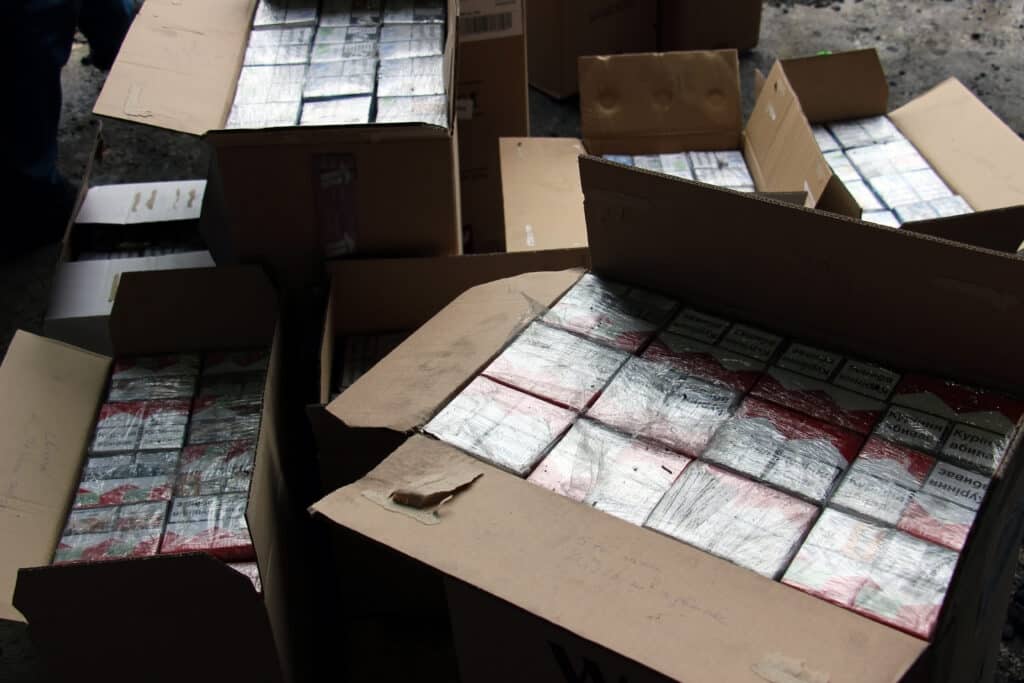
Uganda, land of cigarette trafficking
8 May 2023
Par: National Committee Against Smoking
Dernière mise à jour: 8 May 2023
Temps de lecture: 7 minutes

While the tobacco industry has been constantly denouncing the illicit cigarette trade, two investigations have demonstrated the involvement of at least two cigarette companies, British American Tobacco and Mastermind, in cigarette smuggling in Uganda.
Challenging tobacco tax increases by brandishing the threat of increased illicit trade is a strategy deployed by the tobacco industry in many countries, but particularly in African countries. However, tobacco manufacturers are regularly called into question on issues of contraband.
Investigations by the Organized Crime and Corruption Reporting Project (OCCRP) had thus established, in 2021, the involvement of British American Tobacco (BAT) and Imperial Brands in cigarette smuggling. in Mali, and that of Philip Morris International (PMI) in similar facts in Burkina Faso.
Now, tobacco companies are suspected of profiting from cigarette trafficking in Uganda, according to two journalistic investigations.
BAT suspected of organizing trafficking of its own brands
One such investigation was conducted by a Daily Express journalist, who was able to purchase about thirty packets of contraband cigarettes from various outlets in Kampala, the capital.[1]. Cigarettes of the Dunhill Switch brand bore the Democratic Republic of Congo (DRC) tax stamp, while those of the SM-Sweet Menthol brand appeared to have originated in Rwanda and Tanzania. The collected packs lacked health warnings and other distinctive markings in Uganda. Both brands are produced by the same manufacturer, BAT. The Sportsman brand, jointly produced by BAT Uganda (BATU) and Leaf Tobacco and Commodities (LTC), is also allegedly used to disguise contraband cigarettes.
The presence of these products on the Ugandan market does not prevent BATU from continuing to promote the fight against illicit trade with the government. A "public-private dialogue" on illicit trade was thus organized by BATU on March 16, 2023 in a hotel in Kampala, for Ugandan public actors. The Tobacco Control Act, adopted by Uganda in 2015, prohibits meetings between officials of the country and tobacco producers, as prescribed in Article 5.3 of the Framework Convention on Tobacco Control (FCTC), ratified by Uganda in 2007.
Uganda, crossroads of smuggling routes
Another, more detailed investigation was also conducted in Uganda and published in September 2022 by the Global Initiative against Transnational Organized Crime (GI)[2]She points out that the parallel economy is very established in Uganda for all kinds of products, of which cigarettes represent only a small part. Cigarette and fuel trafficking are, however, those which are the least repressed, in comparison with drug or arms trafficking.
Uganda's geographical location and history of armed movements mean that trafficking routes and the networks that control them are highly institutionalized. The investigation revealed that Uganda has been a source, transit point and destination for cigarette trafficking since the late 1990s, and that this dynamic remains very much alive.
Uganda can therefore be a source of cigarette smuggling for neighbouring countries or be the destination of these traffics, especially from Kenya. A particularity of Uganda, referred to as "round trips" (round tripping), is that some batches of cigarettes officially intended for export are shipped to the DRC or to southern Sudan, before returning through the clandestine network to be sold in Uganda. This system seems complicated, particularly for the chain of intermediaries it involves, but ultimately turns out to be very economical for the manufacturer: it allows the production of duty-free cigarettes, since they are intended for export, to then circumvent the taxation of the country of origin, which turns out to be more expensive than the many other transport costs.
A long-running trial thus pitted Leaf Tobacco against Mastermind, the latter being suspected of having illegally imported Supermatch cigarettes intended for South Sudan. The judge confirmed the illegal nature of these batches of cigarettes, but acquitted Mastermind on the grounds that its responsibility in this trafficking could not be demonstrated. The authors of the GI investigation not only found that the smuggling orchestrated by Mastermind was still active, but they were also able to verify that Supermatch cigarettes, produced in South Sudan by Leaf Tobacco, were also being illegally transported to Uganda.
This difficulty in establishing the responsibility of producer-traffickers is the main obstacle to prosecutions in smuggling cases, with the perpetrators trying as much as possible to delegate the trafficking to third parties in order to escape prosecution.
Endemic smuggling, partly combated by tax increases
The Uganda Revenue Authority (URA), responsible for collecting taxes and excise duties, has estimated the Ugandan government's loss of revenue in uncollected taxes at 30 billion Ugandan shillings (or €7.2 million). Despite numerous efforts and ever-increasing seizures, the Ugandan government has not managed to curb this trafficking. URA agents responsible for collecting taxes are intimidated, threatened with weapons or have their offices set on fire by traffickers. The very small amounts paid to customs officers by cigarette traffickers (2,500 to 5,000 Sudanese pounds, or €17.50 to €35) demonstrate that the level of corruption is particularly high.
Where repression and enforcement are lacking, however, there are other levers to combat smuggling: several studies have shown that increasing tobacco taxes also affects the price of contraband cigarettes, which tends to align with the legal price.[3]. The overall increase in the cost of cigarettes then translates into a general decline in consumption, particularly in low- and middle-income countries, but also into a decline in illicit trade. This probably explains why, before being dismissed, BATU sued the Ugandan government in 2015, when it decided to increase excise duties by 40 %. However, other levers than taxation alone are needed to overcome illicit trade.
Keywords: Uganda, smuggling, round trips, BAT, Leaf Tobacco, Mastermind.
MF
[1] Big Story: BAT Uganda on the spot for smuggling illicit cigarettes, evading billions in tax, Daily Express, published April 6, 2023, accessed May 4, 2023.
[2] Round-tripping, corruption and established smuggling networks: The illegal cigarette trade between Uganda and its neighboring countries, Global Initiative, Risk Bulletin #26, September-October 2022.
[3] Guillermo Paraje, Michal Stoklosa and Evan Blecher, Illicit trade in tobacco products: Recent trends and emerging challenges, Tobacco Control, 31, 2 (2022): 257–262.
National Committee Against Smoking |