Tobacco REP: In the National Assembly, a call to exclude the tobacco industry and ban filters
November 26, 2026
Par: National Committee Against Smoking
Dernière mise à jour: November 26, 2026
Temps de lecture: 10 minutes
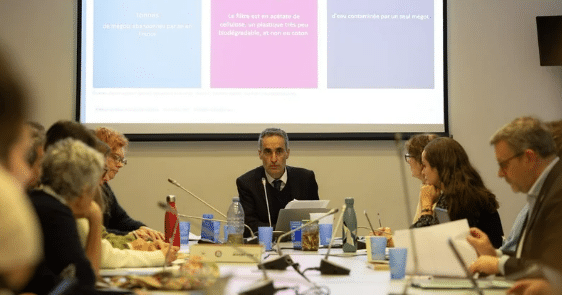
On November 24, 2026, the French National Committee Against Smoking (CNCT) and Surfrider Foundation Europe convened parliamentarians, experts, and representatives of French and European civil society at the National Assembly, under the chairmanship of Member of Parliament Nicolas Thierry, for the 5th edition of the 5.3 Awards for tobacco-free and lobby-free public policies. Discussions focused on the shortcomings of Extended Producer Responsibility (EPR) schemes: the tobacco sector, managed in France by Alcome, an eco-organization governed by tobacco manufacturers, as well as the systems implemented elsewhere in the European Union and the French EPR schemes more heavily invested in by industry. All participants reiterated the principles of the WHO Framework Convention on Tobacco Control (FCTC) and its Article 5.3, which excludes industry from the implementation of public policies. They all agreed on one point: the current tobacco EPR system, entrusted to industry, is a failure and counterproductive. Furthermore, the most effective way to sustainably reduce pollution, particularly plastic pollution linked to cigarette butts, is to ban cigarette filters, regardless of their material.
Since 2021, in accordance with a 2019 European directive on single-use plastics, known as the SUP directive, cigarette manufacturers have been required to pay for the collection and processing of cigarette butts discarded in public spaces: this is the «polluter pays» principle, implemented through an Extended Producer Responsibility (EPR) scheme. In France, this task has been entrusted to an eco-organization, Alcome, approved by the State for six years.
EPR schemes are failing, in France as well as in Europe
According to Surfrider Foundation Europe, cigarette butts are the most common type of litter found during collection operations in Europe.[1]. Made of cellulose acetate, a type of plastic, the filter can take up to 15 years to decompose.[2] and breaks down into microplastics, which the WHO describes as the second largest form of plastic pollution in the world[3]. In water, a cigarette butt can release up to 100 microfibers per day, as well as nicotine and heavy metals.[4].
Alcome is governed by Philip Morris France, Seita (Imperial Brands), Japan Tobacco International, and British American Tobacco France, which sit on its board of directors alongside the president of the Confederation of Tobacconists; it has been chaired since March 2026 by Vincent Zappia, who previously represented British American Tobacco France on the board.[5]. Governance contrary to Article 5.3 of the CFLAT[6][7]. He has been registered in the register of interest representatives of the High Authority for Transparency in Public Life since June 11, 2026.[8]. The organization's expenditures were largely for communication: according to Alcome's activity reports, these expenditures increased more than sixfold between 2022 and 2025, rising from €684,393 to €4.48 million. The eco-organization claims more than 2,030 partner communities.[9]. At the same time, the State has sanctioned it on several occasions: nearly 1.16 million euros in fines were paid in 2024 for shortcomings in the financing of street ashtrays.[10], then a new penalty in June 2025, the administration noting in particular the lack of objectives for valorizing cigarette butts and the inadequacy of research projects[11].
The speakers emphasized that these difficulties are not unique to France. Danielle Van Kalmthout, Director General of the Belgian Alliance for a Smoke Free Society, discussed the transposition of the SUP Directive and the shortcomings of the system implemented in Belgium. Pauline Debrabandere, Advocacy and Campaigns Director of Zero Waste France, broadened the observation to include French Extended Producer Responsibility (EPR) schemes in general, which are also heavily invested in by industries whose interests can conflict with the public interest and the environmental objective being pursued.
Article 5.3 of the CFC at the heart of the discussions
All participants reiterated the principles of the FCTC, ratified by France and the European Union. Article 5.3 requires public authorities to protect their public health policies from the commercial interests of the tobacco industry, these policies encompassing all of the industry's activities, including those in the environmental field. The implementing guidelines recommend limiting interactions with this industry to what is strictly necessary, refusing partnerships, and not endorsing its so-called social or environmental responsibility activities.[12]. For the participants, entrusting the tobacco industry with the governance of a public waste management policy amounts to offering it a showcase and direct institutional access to communities and public decision-makers.
MP Sylvie Ferrer (Hautes-Pyrénées, La France Insoumise) denounced the inaction of her parliamentary colleagues on the issue. She recalled that her written question on the «problematic governance of the eco-organization Alcome,» published in the Official Journal on May 19, 2026, in which she asked the Government to comply with Article 5.3 by approving an eco-organization independent of tobacco manufacturers, had gone unanswered.[13]. She called for swift action, as Alcome's license expires in August 2027.
This symposium was held in conjunction with the presentation of the 5.3 Awards for tobacco-free and lobby-free public policies, awarded by the CNCT (National Committee Against Tobacco). These awards aim, on the one hand, to raise awareness of dysfunctions and interference by the tobacco industry in public policy, and on the other hand, to recognize initiatives that, conversely, protect public policies from such interference. For this edition, the 5.3 Negative Award was given to Alcome for having used extended producer responsibility as a tool serving the tobacco industry and as a point of entry into the development of public policy. The Positive Award was presented to Member of Parliament Nicolas Thierry, in recognition of his commitment in Parliament, particularly through his proposed legislation for a tobacco-free generation and for extending plain packaging to all tobacco and nicotine products, with a consistent approach to safeguarding these measures from tobacco industry interference.
The Dutch model and the ban on filters as a horizon
The symposium also brought together stakeholders from the Netherlands, including Jaap Dinkelman, Senior Waste Officer at the Dutch Ministry of Infrastructure and Water Management. He presented the Dutch experience, which has successfully kept the tobacco industry out of the system. In the Netherlands, manufacturers finance the costs associated with cigarette butts, but these costs are assessed by the government based on studies and monitoring of discarded waste. The figures are published annually in the Dutch Official Gazette: for 2025, the costs attributed to plastic filters were estimated at nearly €28.7 million, in addition to €1.1 million allocated to awareness campaigns.[14].
Public authorities are leading the actions. Thus, the regulations explicitly stipulate that tobacco producers do not implement awareness campaigns themselves.
Beyond governance, all stakeholders agreed on one point: the most effective way to sustainably reduce pollution, particularly plastic pollution from cigarette butts, is to ban cigarette filters outright, regardless of their material. In 2019, the SUP Directive recognized filters as one of the most common types of plastic waste in Europe, without banning them or setting reduction targets, unlike other products such as straws or cotton buds.[15]. Its revision, expected by 2027-2028, offers an opportunity to correct this shortcoming; the Netherlands and Belgium have already declared themselves in favor of a ban[16]. In June 2026, in its contribution to the European Commission's consultation on the revision of the Tobacco Products Directive, France explicitly supported a ban on filters for the first time.[17].
At the conclusion of the symposium, the CNCT (National Committee Against Tobacco) and Surfrider Foundation Europe issued six recommendations, including the exclusion of tobacco industry representatives from all governance bodies, management of the sector by a public or independent entity, direct funding allocated to local authorities, transparency in the sector, and a ban on filters in France, the European Union, and the future international treaty on plastic pollution. «The Alcome experience demonstrates the need to strictly separate the tobacco industry's financial contribution from any participation in public action,» emphasized Professor Yves Martinet, President of the CNCT. «It is urgent to revise this model to put environmental protection and pollution prevention at the heart of this system,» added Lisa Pastor, Advocacy Manager for Surfrider Foundation Europe in France.[18].
Photo credit: Nicolas JampierreAE
[1]Surfrider Foundation Europe, «Science as a compass. 2025 fundraising report», March 2026, accessed November 25, 2026.
[2]RTBF, «4.3 trillion cigarette butts are thrown on the ground every year, and this has consequences.», July 11, 2018, accessed November 25, 2026.
[3]WHO, «WHO raises alarm on tobacco industry environmental impact», May 31, 2022, accessed on November 25, 2026.
[4]Futura Sciences, «Cigarette butts release deadly toxins into the environment», May 5, 2023, accessed November 25, 2026.
[5]Alcome, «Our organization», Page updated on November 12, 2026, accessed on November 25, 2026.
[6]CNCT and Surfrider Foundation Europe, press release «Tobacco EPR sector: as Alcome's accreditation renewal approaches, CNCT and Surfrider Foundation Europe call for the tobacco industry to be excluded from the eco-organization», November 24, 2026, accessed on November 25, 2026.
[7]WHO, «Guidelines for the implementation of Article 5.3 of the WHO Framework Convention on Tobacco Control», 2008, accessed on November 25, 2026.
[8]High Authority for Transparency in Public Life, register of lobbyists, Alcome record, registration of June 11, 2026, accessed on November 25, 2026.
[9]Alcome, «Documentary Resources» (activity reports 2022 to 2025), 2022-2025, accessed on November 25, 2026.
[10]Tobacco-Free Generation, «The eco-organization Alcome condemned once again by the State», June 2024, accessed on November 25, 2026.
[11]Ministry of Ecological Transition, penalty order against the company Alcome, June 19, 2025, accessed November 25, 2026.
[12]WHO, «Guidelines for the implementation of Article 5.3 of the WHO Framework Convention on Tobacco Control», 2008, accessed on November 25, 2026.
[13]National Assembly, written question no. 15179 from Ms. Sylvie Ferrer, «Problematic governance of the eco-organization Alcome», Official Journal of 19 May 2026, accessed on 25 November 2026.
[14]Staatscourant, 2025, n° 18866, 2025, accessed on November 25, 2026.
[15]Directive (EU) 2019/904 of the European Parliament and of the Council on reducing the impact of certain plastic products on the environment, June 5, 2019, accessed November 25, 2026.
[16]No (Plastic) Filter, «A European ban on cigarette filters in the Single-Use Plastics Directive (SUPD)», October 15, 2025, accessed November 25, 2026.
[17]Tobacco-Free Generation: «France is pushing the European Union towards more ambitious regulations on tobacco and nicotine», June 20, 2026, accessed November 25, 2026.
[18]CNCT and Surfrider Foundation Europe, press release «Tobacco EPR sector: as Alcome's accreditation renewal approaches, CNCT and Surfrider Foundation Europe call for the tobacco industry to be excluded from the eco-organization», November 24, 2026, accessed on November 25, 2026.
National Committee Against Smoking |