IQOS «Curiosity»: a Philip Morris campaign that speaks to young people
July 22, 2026
Par: National Committee Against Smoking
Dernière mise à jour: July 21, 2026
Temps de lecture: 7 minutes
A study published in Tobacco Control[1] This reveals that Philip Morris International's (PMI) new global campaign for its IQOS heated tobacco product, built around the theme of "curiosity," is leveraging particularly effective psychological triggers among teenagers and young adults. While PMI claims to be targeting adult smokers exclusively, an analysis of 178 advertisements and dozens of official social media accounts highlights an advertising strategy that deviates from this institutional narrative.
The authors, affiliated with Stanford University and Yang Ming Chiao Tung University in Taiwan, compiled their corpus from social media accounts directly managed by PMI: 20 national Instagram accounts, 2 Facebook accounts, and 10 X (formerly Twitter) accounts, supplemented by promotional videos published on YouTube, Vimeo, and TikTok. All posts published between May 2024 and December 2025 were reviewed, yielding 178 advertisements related to the theme "Curiosity." The researchers further enriched this work by examining the company's press releases, statements from its executives, and articles published in celebrity and lifestyle publications.
A global version, present in around twenty countries
Launched in 2024 and still active in 2026, the "Curiosity" campaign uses the same concept under several different brandings: Stay Curious, Forever Curious, Curious?, Curious X or even Unlock Your Curiosity. The vocabulary used consistently emphasizes discovery, innovation, exploration, creativity, and inspiration, with taglines such as "a new experience," "open your mind," or "let life surprise you." At the time of the study, the authors identified this communication on IQOS's official Instagram accounts in twenty countries: Azerbaijan, Canada, Dominican Republic, Egypt, Greece, Guatemala, Indonesia, Italy, South Korea, Lebanon, Malaysia, Mexico, Morocco, Philippines, Romania, Serbia, Spain, Tunisia, United Arab Emirates, and the United Kingdom.
The campaign is being promoted through dedicated hashtags (#forevercurious, #iqosstaycurious, #curiousx), sponsored art and music events, and media partnerships with publications such as Vogue, Rolling Stone, Forbes Or Cosmopolitan, as well as by influencers followed by tens of thousands, or even more than a million people. The authors note that the commercial link of these influencers with PMI is not always mentioned in their posts, which blurs the line between personal content and commercial advertising.
«"Curiosity," a word that replaces the brand, and an institutional discourse contradicted by the facts.
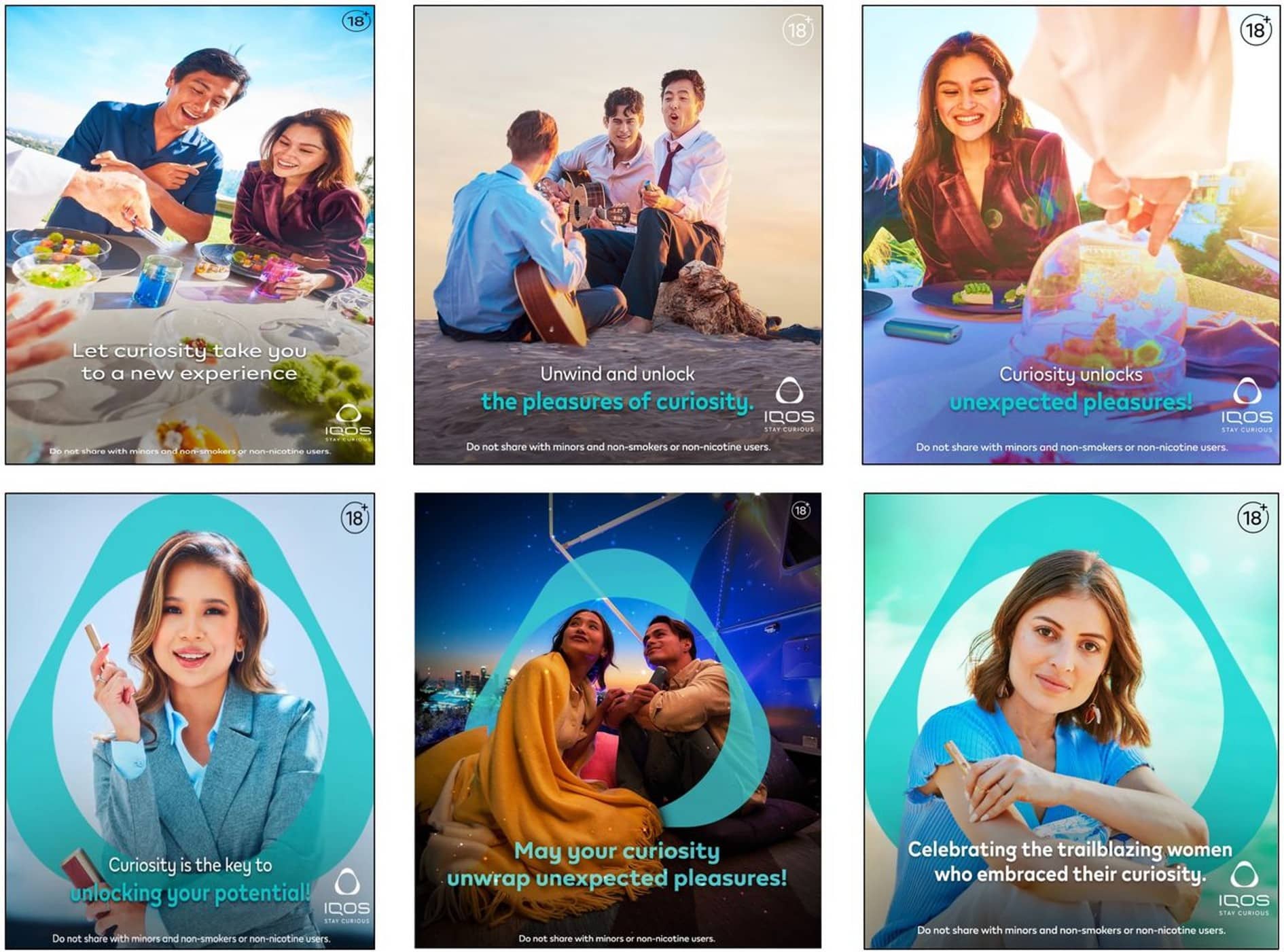
One of the study's main contributions concerns the use of the word "curiosity" as a euphemistic substitute for the brand name IQOS. The authors show that in many slogans, it is possible to directly replace the word "curiosity" with "IQOS" without changing its meaning: "curiosity unlocks unexpected pleasure" thus becomes "IQOS unlocks unexpected pleasure." This practice is part of a broader tradition within the tobacco industry, which has developed euphemistic vocabulary over the decades to mitigate the perception of risks: IQOS is presented as a device "that heats without burning" and "smoke-free," as part of corporate communications that claim a "smoke-free future." The authors point out that independent chemical analyses have shown that IQOS emissions contain toxic substances similar to those found in cigarettes, albeit in lower concentrations, which contradicts the product's presentation as a "smoke-free" device.
PMI also consistently presents IQOS as a product for adults who already smoke cigarettes, not as a starter product; its executives have publicly described the "Curiosity" campaign as a celebration of exploration, creativity, and pushing boundaries, without any explicit reference to tobacco or nicotine. The authors also note that one of the campaign's slogans, encouraging users to "step outside their comfort zone," seems hardly compatible with the promotion of an addictive and harmful product.
The study, however, confronts this narrative with several factual observations: the campaign's vocabulary and aesthetics—smiling models in festive settings, themes of adventure, self-confidence, and romantic success—intersect with approaches identified in marketing literature as particularly effective with young audiences. The authors emphasize that curiosity, as a psychological trait, reaches its peak during adolescence, and that previous research has already established a link between curiosity and the likelihood of experimenting with tobacco or e-cigarettes among young non-smokers. They also note that the campaign's preferred distribution channels—Instagram, TikTok, and YouTube—are those on which teenagers spend proportionally more time than adults.
A variation on the classic mechanisms of tobacco
The authors situate this campaign within the continuity of historical tobacco advertising strategies while identifying a unique feature: to their knowledge, it is the first time a tobacco brand has created a campaign explicitly centered on the theme of curiosity, a distinctive characteristic similar to a contemporary Camel cigarette campaign that plays on a similar register. The study also notes the use of the brand's visual code, whose blue hue is reminiscent of that associated with luxury goods, combined with gold elements intended to evoke refinement. The authors specify, however, that their work constitutes a qualitative analysis of a given advertising theme and not an exhaustive quantitative study of all IQOS communications: the campaign's true appeal to young audiences could only be established through studies directly examining consumer perception, which this article did not attempt to measure.
Exposure to advertisements is amplified by the cross-border nature of the issue.
The study reiterates that Article 13 of the WHO Framework Convention on Tobacco Control (FCTC) commits Parties to implementing a complete ban on all forms of tobacco advertising, promotion, and sponsorship. However, the authors note that IQOS's national social media accounts remain accessible from any country, even when the brand's websites are geographically restricted. Since major social media platforms generally prohibit paid tobacco advertising, PMI relies on unpaid accounts and the virality amplified by hashtags and influencers—a distribution method that effectively circumvents the existing ban and multiplies public exposure beyond the borders where the brand is officially authorized to advertise. Finally, the authors note that the U.S. Food and Drug Administration (FDA) is expected to rule in 2026 on an application for a modified risk designation for IQOS, a decision that will need to take these factors into account.
This failure to enforce the ban in the face of the cross-border nature of online advertising was discussed at the last two Conferences of the Parties (COPs) to the WHO's FCTC. This issue is also central to the ongoing work at the European level within the framework of the revision of the directive governing tobacco advertising.
[1] Yin T, Jackler RK Philip Morris International's youth-appealing 'Curiosity' IQOS advertising campaign Tobacco Control Published Online First: 17 July 2026. doi: 10.1136/tc-2025-059949
AE