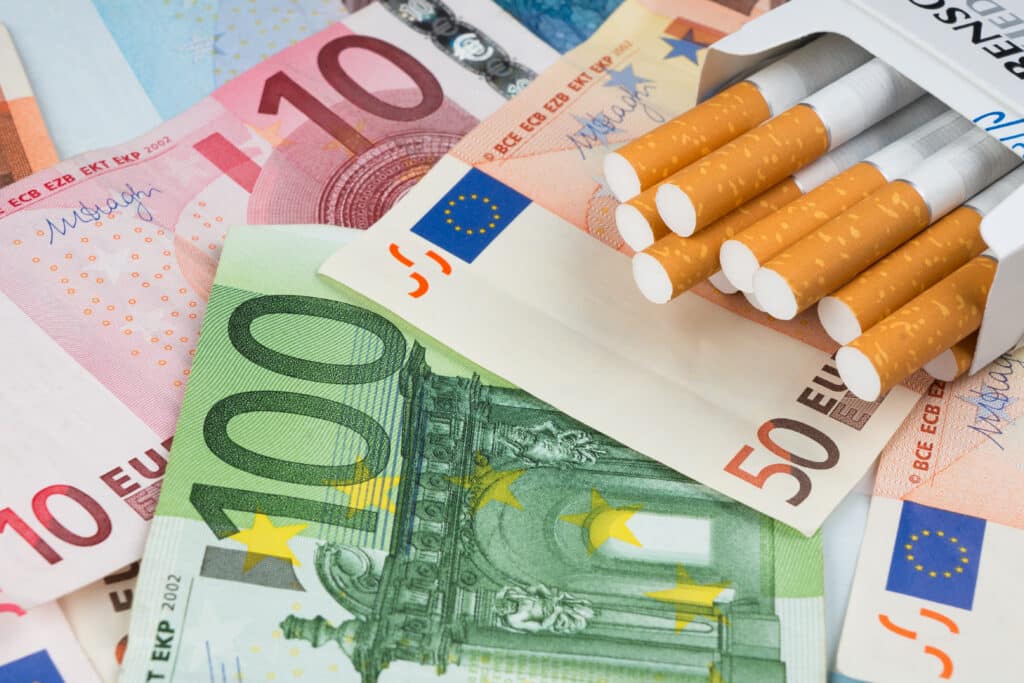
The ISR Label announces the sectoral exclusion of tobacco
April 19, 2023
Par: National Committee Against Smoking
Dernière mise à jour: April 19, 2023
Temps de lecture: 4 minutes

The Socially Responsible Investment Label, set up by the French Ministry of Economy and Finance, has announced that it is proceeding with a sectoral exclusion for tobacco, after a review process that began several months ago. This decision was welcomed by those involved in the fight against smoking, but also by players in the economic and financial world.
The SRI Label was launched in 2015 by Michel Sapin, then Minister of Economy and Finance, with the aim of guiding savers and investors towards sustainable investments, in line with human, environmental, social and governance imperatives.
A review process initiated to respond to criticisms made against the Label
In 2020, a report from the General Inspectorate of Finance estimated that the lack of requirements of the Label put it at risk of a " loss inescapable of credibility and relevance ", and recommended carrying out " Normative and sectoral exclusions ", particularly for tobacco. A process of revision of the Label was initiated, involving a phase of consultation with public health organizations, such as the National Committee against Smoking (CNCT) or the Alliance against Tobacco (ACT), but also with stakeholders from the economic and financial world. This consultative phase resulted in the definition of new orientations, including the sectoral exclusion of tobacco.
The incompatibility between socially responsible activities and the tobacco industry's record
The decision of a sectoral exclusion was initially welcomed by public health in view of the human, health, environmental, social and economic cost caused by the tobacco industry. Thus, each year, the tobacco industry is responsible for the premature death of eight million people worldwide, including 75,000 in France. Furthermore, tobacco is one of the most polluting and environmentally destructive sectors: the tobacco industry is responsible - among other things - for 5% of global deforestation, lasting pollution of soil and water, as well as the production of 6,000 billion cigarette butts, the vast majority of which end up in nature. Public health organizations also emphasize that the tobacco industry is not a socially responsible player, given the multiple legal convictions it has been subject to in France and elsewhere. The tobacco industry's activities directly oppose 14 of the 17 UN Sustainable Development Goals. For all these reasons, the WHO Framework Convention on Tobacco Control (FCTC) posits the existence of a fundamental and irreconcilable conflict between the interests of the tobacco industry and those of public health.
An exclusion in accordance with national and international regulations
The issue of maintaining or excluding the tobacco industry from this Socially Responsible Investment Label is therefore that of the denormalization of a separate sector, through the damage it causes. The presence of tobacco in an SRI Label, set up by the public authorities, also raises the question of the latter's independence with regard to cigarette manufacturers. The FCTC, ratified by France in 2004, requires Parties to guarantee the full independence of public decision-making from the influence of cigarette manufacturers. Furthermore, the implementing guidelines for Article 5.3 recommend that public authorities "not grant preferential treatment to the tobacco industry". More generally, the Framework Convention, like the Public Health Code, prohibits any form of sponsorship of the tobacco industry, in that it constitutes an indirect promotion for tobacco, in the same way that any form of advertising given to so-called "socially responsible" commercial practices on the part of cigarette manufacturers is also prohibited.
Keywords: ISR Label ©Generation Without TobaccoFT
National Committee Against Smoking |