Parallel tobacco markets: KPMG report contested
June 14, 2022
Par: National Committee Against Smoking
Dernière mise à jour: June 14, 2022
Temps de lecture: 6 minutes

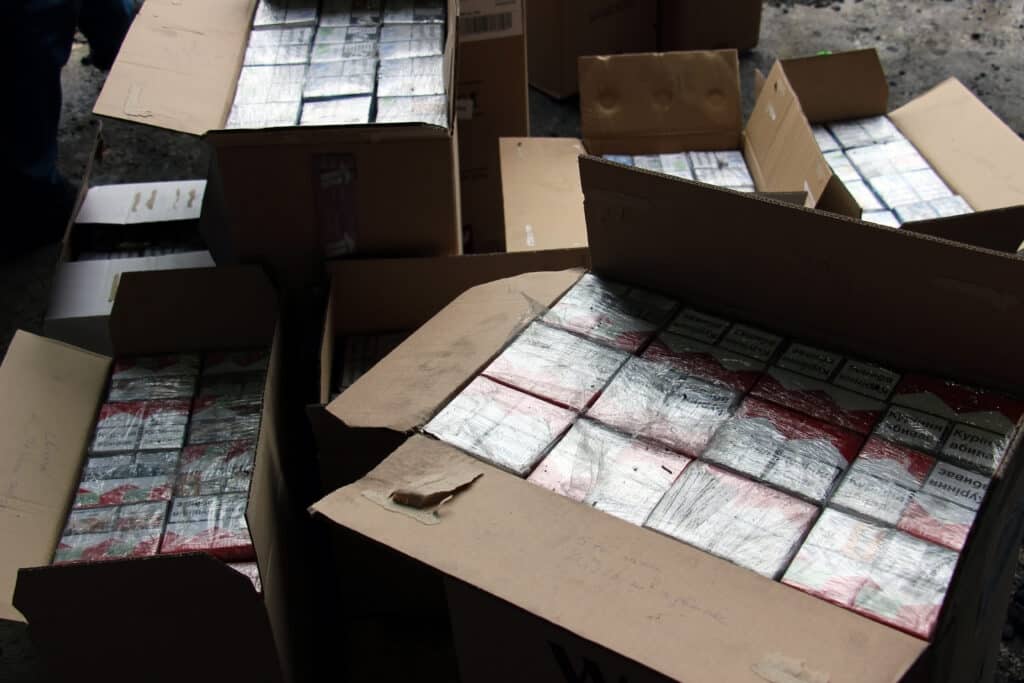
In a note published on June 14, the National Committee against Smoking (CNCT) questions the results of the previous KPMG report on illicit trade in France, which tends to overestimate the share of counterfeit products.
Every year, the KPMG institute produces a report on the evolution of the illicit trade in tobacco products in France, notoriously financed by Philip Morris International (PMI). Anticipating the release of the next KPMG report, the CNCT indicates in a recent note how the figures of this type of study are misleading and overestimated[1].
Reliability of KPMG report questioned
In the preamble to each of its reports, KMPG mentions that it does not "having sought to establish the reliability of the sources of information"A methodological flaw that the CNCT does not fail to point out, pointing out certain inconsistencies in the figures in the report on illicit trade.
The data from the KPMG study is based on the collection of empty packets picked up on the road in Europe, which are then sent to cigarette manufacturers so that they can distinguish between packets from their factories and those that are fraudulently produced by third parties. This appears to be a flagrant lack of independence in the processing of this data, and may seem strange when we know that PMI negotiated an agreement with the European Commission in 2004, providing for fines in the event of a significant presence of its products among the contraband products seized. This agreement therefore encourages the manufacturer to overestimate the share of counterfeit products, in order to evade its participation in the contraband activities and to present itself as a victim of this traffic.
Overestimation of counterfeit products
KMPG had thus established in 2021 that counterfeiting would have increased by 600 % in France, between 2019 and 2020, and that it would represent 11.76 % of national tobacco consumption. Figures which would indicate a meteoric rise in these products, of the order of nearly 300 million packets, which seems difficult to organize so quickly. These data are notably in contradiction with those published in a study commissioned by Seita-Imperial Brands in 2016, which placed this share of packets from counterfeiting at 0.2 % of the French market. They are also very different from the work of the National Assembly's fact-finding mission, which estimated in September 2021 that the parallel market in France would be between 14% and 17% of the internal market, three-quarters of which are in fact perfectly legal cross-border purchases.[2]The remaining quarter would consist mainly of contraband products, which cigarette manufacturers are strongly suspected of supplying traffic, and much more marginally of counterfeit products. The figures that cigarette manufacturers communicate to the media and public authorities place off-network purchases at 30% of the French market, by assimilating legal cross-border purchases to trafficked products and significantly overestimating the share occupied by counterfeit products.
Effectively combat illicit trade
"We are not seeking to deny the reality of the parallel market, but to anticipate and neutralize the communication that takes place every year around this report, which serves as a lever for communication with elected officials," specifies François Topart, the spokesperson for the CNCT[3]. The tobacco industry claims that the supposed increase in illicit trade is the consequence of policies to increase tobacco taxes, which contradicts observations made in high-income countries. The presence of illicit trade is mainly noted in low- and middle-income countries, where corruption is widespread and which do not have a good system for controlling supplies. A recent counter-example is nevertheless provided by Sierra Leone which, despite a low level of income, has managed to curb this illicit trade.[4].
To combat smuggling and counterfeiting, the CNCT proposes to follow the recommendations of the Protocol to Eliminate Illicit Trade in Tobacco Products, supported by the World Health Organization (WHO), and to amend Article 15 of the European Tobacco Products Directive (TPD), according to which the collection and storage of data on illicit traffic is carried out by cigarette manufacturers. The CNCT suggests not only setting up an independent system for collecting data on illicit trade, but also establishing supply quotas by country based on their actual domestic consumption in order to avoid oversupply of tobacco in border areas, as is currently the case for Luxembourg. The association also defends the idea of reducing cross-border purchases to three packets per person (60 units). Finally, it points out that the most effective way to reduce illicit trade is to reduce tobacco consumption, which can be achieved in particular by increasing taxes on tobacco products significantly and regularly.
Keywords: illicit trade, counterfeiting, cross-border purchases, KPMG, CNCT
MF
[1] Fighting the illicit tobacco trade in France, CNCT, published June 14, 2022, consulted June 14, 2022. [2] Information mission on the evolution of tobacco consumption and the yield of taxation applicable to tobacco products during confinement and the lessons that can be learned from it, National Assembly, September 2021. [3] Godeluck S, Tobacco: counterfeiting overestimated, Les Echos, published June 14, 2022, consulted June 14, 2022. [4] Sierra Leone: Tobacco tax hikes reduce smoking and smuggling, Generation Without Tobacco, published June 9, 2022, consulted June 14, 2022. National Committee Against Smoking |